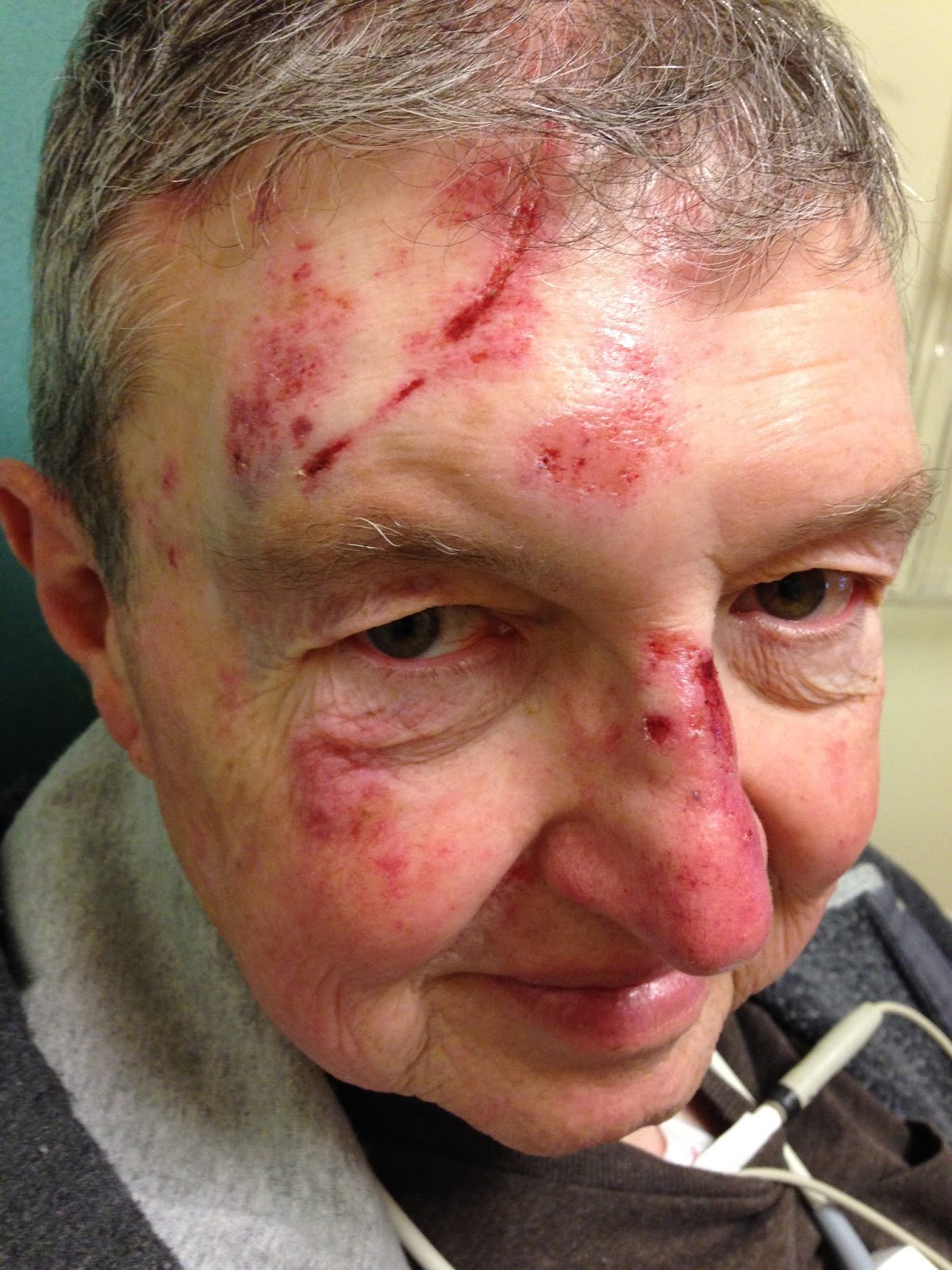
Wednesday, May 29, 2019

"Aaaaand, you are holding"

If you've seen "The Way Way Back," then I'm sure you remember the scene where Nat Faxon keeps a PYT from going down the ramp by asking her for about a minute to "hold."

If not, watch this. I'll hold while you do it.


Also, if you haven't seen "The Way Way Back," go get it. Get it now. Watch it. Watch it again. Have tissues at the ready.

OK. Back to us.

So, we saw the surgeon today, Dr. Song. He and his staff were awesome, until you could tell that he had other things to do and he stopped listening to us, but I get ahead of myself.

First the nurse came in, took all his vitals and history. Then the physician's assistant and speech/swallowing therapist came in. The P.A. took more history and talked more specifically about the cancer. Then he decided he needed to do a bunch of unpleasant things, like sticking a tube up Vic's nostril to deaden the back of his tongue, then stick a camera up that to look inside, only to decide that he should have done all that on the other side. So he stuck another tube up Vic's other nostril to deaden his tongue more, then stuck another camera up his other nostril and root around in there to see what he could see. Vic didn't like this tube-nostril thing.


Then Dr. Song came in. First he reviewed the video from the tube-nostril thing. As the camera progressed through Vic's various body parts, he talked about what we were seeing. That was pretty cool.

Then he decided he needed to stick his finger in Vic's mouth to feel around. He used a numbing spray that he said would taste terrible, like a "funky banana." Vic said it wasn't that terrible. Then he put more numbing stuff on the cancer side of the tongue. He really didn't want Vic to feel anything as he was rooting around in Vic's mouth. Then he did a lot of feeling around, much of which was painful despite all that funky banana numbing. He said he didn't feel anything on the left side, and what he felt on the right was broad (2.5 cm, about an inch) but it didn't seem very deep. When Vic accidentally bit the doctor's finger, the doctor decided to stop feeling around. He said his finger is very important to him. I'm thinking if his finger is so darned important, maybe he should tell patients not to bite it before he puts it in their mouths. But I digress.

Then he reviewed the PET scan. Again, he showed how different things were "lighting up" on the scan. First, the brain, which showed normal activity. Vic made a brain joke, which the doctor did not appreciate, because he had a brain joke of his own ("So, Mrs. Love, he has a brain, and it works.") and thought Vic stole his thunder.

As he went through each layer of the PET scan, he described what it was showing--some inflammation in the back of his neck, noting in the lungs, nothing in the heart, nothing in the liver, nothing in the kidney, nothing in the bladder. We heard all that from Dr. Maymani (the oncologist), but it was nice to hear all that from a second doctor.

Based on what he can see on the PET scan, it's early-stage cancer, probably T1 or T2, for those of you familiar with the tumor grade classification system of cancer. This, too, is good news and was nice to hear.

After all this, Dr. Song started describing the surgery, which he said would remove a portion of the tongue (a "partial glossectomy," for those of you who like to look things up). (Again, this is good news—Dr. Maymani couldn't say whether Dr. Song would even perform the surgery.)

In the drawing below, there is a shaded circle on the right side—this is the cancer. (The shaded circle at the back is where the previous cancer was.) Then there is a solid line around it--this is the part the doctor would remove.


While Vic is still under anesthesia, a pathologist would examine the specimen to determine whether Dr. Song got all the cancer. (This is called having clean margins.) If he did, Dr. Song would close the wound, procedure complete. If not, Dr. Song would remove more of the tongue. This is the area shown by the first dotted line outside of the solid line. The pathologist would examine the specimen again, if it still didn't have clean margins, Dr. Song would remove more. Lather, rinse, repeat, until the margins are clean—that is, all the cancer is gone.

The next step depends on how much of the tongue Dr. Song has to remove. If he removes a bunch, then he'll also perform reconstructive surgery at the same time—taking a bit of flesh and tissue from other parts of the body to use as "filler" for the tongue.

Dr. Song also wants to remove the lymph nodes on the right side of Vic's neck. That's less of a problem—it's just an incision on the neck, remove the lymph nodes, close it back up.

Dr. Song does not believe he would need to take part of the mandible (jaw) as Dr. Maymani suggested—Dr. Song says the mandible doesn't seem to be involved at all. That is great news, because Vic was really worried about that.

Vic may also need radiation after surgery, but the dose would be much smaller.

Vic could do radiation before surgery—try to kill it that way, making surgery unnecessary—but the radiation would be a higher dose (with presumably higher side effects) and the surgery would be more difficult after radiation.

AND FINALLY (for this part of the story), Dr. Song also discussed what it would be like if Vic chose to do nothing. He said he couldn't say how long it would take to kill Vic, and it's a horrible way to die. "I urge you to get treatment," he said. We had talked about "doing nothing" when Vic was initially diagnosed, but Dr. Maymani also said it would be very painful and awful, so we took that option off the table at that point.

Then we asked some questions:

  • Best-case scenario—the surgery where he takes the least amount of the tongue and Vic has no radiation after—what does that look like? He'd be in the hospital for three to five days, get some speech and swallow therapy, some follow-up visits, and he'd probably start to feel better in about four weeks.
  • Near-worst-case scenario—the surgery where he takes the most amount of the tongue but Vic still has no radiation after—what does that look like? He'd be in the hospital for about a week, but he wouldn't start to feel better for months instead of weeks. He wasn't more specific about how many months.
    • As for what happens if you add radiation to the surgery, we won't know until Tuesday, when we see the radiation oncologist Dr. Weeks.
  • What effect will the surgery have on Vic's everyday life? None—he'll still be able to drive, walk, eat, swallow (although obvi the last two are with therapy), etc. The only problem would be if he had something go wrong during the surgery, such as a stroke or major cardiac event on the table. Dr. Song really felt that Vic has a good chance at a high quality of life with treatment. (Although his definition of "quality of life" might differ from Vic's.)
This was the point where I feel Dr. Song was starting to get frustrated with us. He kept asking if we had any questions, but he also kept looking at his watch. Vic was trying to ask good questions, but Dr. Song got a little fixated on thinking that Vic wanted to refuse treatment—like Vic was trying to decide whether he was going to even have treatment. And he kept saying "You should really get treatment." But Vic was just trying to get more information about what the recovery would be like so he could make an informed decision about which treatment to get. I get it—there are still so many "what-ifs" that it's hard for Dr. Song to give specifics, but I still feel he wasn't fully listening to Vic.

We finished the round of questions, and Dr. Song left us with Liz, the speech/swallowing therapist. She was wonderful. Here are some of the things we talked about with her:
  • The base of the tongue (in the back) is the "powerhouse of swallowing." Dr. Song is not going to touch the back of his tongue, so he really shouldn't have any long-term swallowing problems. Obviously, the early days after surgery could be difficult—but long term, he should go back to normal.
  • She was the one who told us that any reconstructions would take place during the initial surgery. I know we were thinking that he'd get the cancer out, and then he'd have to wait a while for reconstruction—but nope. It will all be on the same day. For me, this was more comforting.
  • She also said the most common outcome is that the first piece he takes out is enough. It is uncommon that he would have to take a whole lot of the tongue.
The unfortunate thing is that we just can't know what is going to happen until Dr. Song gets in there. An MRI would make all of this more clear, but Vic can't have one because of his defibrillator/pacemaker. So at this point, we just have to make a blind decision.

After we finished with our appointment, we drove back through Denver to get home. (The doctor is in Aurora, people. AURORA.) And I thought it was kind of cruel that, in stop-and-go traffic, we had to follow this:


I mean, at one point, I thought, "I'm just gonna stop the car, run up to the van and ask if they have any cupcakes." But common sense prevailed, and I did not get out of the car on I-70.

So, where are we now? Well, we still need to gather a bit more intel first. Dr. Song wanted us to see Dr. Weeks and Dr. Maymani again, find out what they recommend, now that they have Dr. Song's opinion. We see Dr. Weeks on Tuesday next week, and Dr. Maymani on Wednesday.

So once again, we are in a holding pattern until we get the final tidbits of information and Vic decides precisely what treatment he wants to get.

Thanks for "holding" with us!

P.S. If you are concerned that you might miss a blog post, you can subscribe to the blog or you can ask me to add you to my mailing list, and I'll send you a link to the blog whenever I post one. Just send me an email, a text or a DM on Facebook!

Sunday, May 26, 2019

PET Sounds

TL;DR
PET scan shows just one small speck of cancer on Vic's tongue—nothing in the lymph nodes, nothing of significance anywhere else. Next stop: What will the treatment be?

Full blog post
When last we met, I was writing the blog and Vic was taking pictures of birds at our feeder, particularly our beautiful Western Tanagers.


Taking pictures and watching the wildlife that comes to our yard (a wide variety of birds, squirrels, a skunk, a raccoon [or two], a fox and our neighbor's cat) are two of the activities that help Vic feel normal and take his mind off the cancer —even if only for a moment.

OK. So. The PET scan. It went about as expected—it took a long time, but at least it was boring. No need to dwell on that, except for these pictures Vic took while he was there:

You know how people always take pictures of their feet?

The dreaded donut.

We saw the oncologist, Dr. Maymani, Friday. He is a genial fellow who nevertheless uses big words that I continually had to say "Ummm, what does that mean?" Note to all you medical professionals out there: It's OK to use big words, but do please follow-up with "What that means is ..." Thank you.
  • The PET uses a "radio-labeled glucose" that is attracted to areas with high activity, such as the brain and the organs—and cancer cells.
  • The PET found a teeny-tiny dot on the right side of the tongue 👅near the mandible (jaw). Vic said, "Wow, that cancer really is small. Dr. Maymani said, "That's your brain. The cancer is over here." It's so small that it basically only shows up in one of the many, many views of the PET scan.
  • The PET did not find any dots—teeny-tiny or otherwise—in the neck (lymph nodes).
Bottom line of the PET scan, the cancer has not metastasized. For those of you who do not watch Game of Thrones Grey's Anatomy, what that means is (medical professionals: see how I did that?) that the cancer has not spread. This was the absolute best news we could have gotten from the PET, other than "The biopsy was wrong. You don't have cancer. Sorry!" 😉

Now, here's where the news from the PET scan goes a little downhill: Treatment.
  • Surgery is Dr. Maymani's preference.
    • Pros:
      • Surgery removes the cancer. If there is no cancer left, it can't spread.
      • If the surgeon (Dr. Song) thinks he got all the cancer, there would likely be no follow-up treatment (radiation and chemo- or immunotherapy). For those of you who remember the last round of treatment, you know why this is a pro.
    • Cons:
      • Any surgery is risky.
      • While emotionally, Vic's heart is big and full, physically his heart is not strong. Surgery will take a toll.
      • Even though the tumor is small, Dr. Song may have to take a large area of the tongue or even the jaw to make sure he gets the whole thing. This would require a much more extensive surgery as well as reconstruction later on.
      • The medical team (Dr. Song, Dr. Maymani and the radiation oncologist Dr. Weeks) may decide he needs follow-up treatment in addition to the surgery.
  • If surgery is not an option, the next best treatment is radiation therapy.
    • Pros:
      • Radiation kills the cancer. If the cancer is dead, it can't spread.
    • Cons:
      • Radiation therapy sucks. Just read past entries of this blog.
      • He may still have to do chemo. (This would be decided by Dr. Maymani and Dr. Weeks.) Radiation and chemo? That's a low blow.
  • If surgery and/or radiation are not options, the next best treatment is chemo.
    • Pros:
      • Chemo shrinks the tumor (but doesn't kill it, which is a con, obvi).
      • There are newer versions of chemo that weren't available last time around and may have fewer side effects.
    • Cons:
      • Chemotherapy only keeps the cancer at bay for awhile—so it could recur.
      • Side effects, side effects, side effects. Even the newer version of chemo will have side effects. The last round of chemo was not great for Vic.
  • And if all of the above are not options, the final possibility is immunotherapy.
    • Pros:
      • Immunotherapy targets your T cells, which boosts your immune system. If it works, you're immune to that cancer for life.
    • Cons:
      • Immunotherapy doesn't work for everyone.
      • You have to have repeat PET scans. Vic doesn't like repeat PET scans.
      • More side effects! In this case, immunotherapy also targets other organs and can cause colitis, pneumonitis and other inflammation—all treatable, but still ...
It was a little hard to feel hopeful after this appointment, even though the overall news was great. If the cancer had spread, this would be a very different blog post. But now it's been a couple of days, and we've had more time to process. We definitely are grateful that the cancer has not spread, and we are not putting the cart before the horse (translation: we are waiting to freak out until we know what, exactly, to freak out about).

Next steps: We have an appointment with Dr. Song on Wednesday, May 29. This should give us most of the answers we need to determine what to freak out about decide on a course of treatment. We are "looking forward" to that.

I asked Vic if he wanted to say anything in the blog. He said, "I gave you a whole sentence already when I let you use that joke about my brain."

He's a joker. Also, an excellent photographer. When he can't sleep because he's worried about his cancer, sometimes we are the beneficiaries.


Thanks, as always, for all of your support and love and yadda yadda yadda. 💓

Sunday, May 19, 2019

The Waiting Game of Thrones

OK, to be honest, I only threw in "of Thrones" because tonight is the series finale of Game of Thrones. Game of Thrones really doesn't have anything to do with this post.

But as an aside, did you notice no one ever gets cancer on Game of Thrones? They either get murdered or ... nope. That's it. They only get murdered. All in all, not the worst way to die. Unless you cross Cersei, and then it will probably be long and painful.)

So, here we are in the waiting game. As you may remember, before Vic can do anything to treat the cancer, he has to find out more about the cancer, and to do that, Vic needs a PET scan and visits to the doctor. As of the last post, we did not have any of that scheduled. But now we do!

First, we are waiting for the PET scan, which is scheduled for Wednesday, May 22, at 7:30 a.m. (Yawn.) It's a fun affair where you have to drink something super gross tasting, and then you sit and wait in a room that feels a lot like a gas chamber—albeit with a comfortable chair. And there's only gas if you provide it yourself. You can't do anything while you're waiting—you can't play games, read, or even blink. (OK, maybe you can blink.) You can listen to music, but don't even think of tapping your toes! Then they come and get you to lie down in a tube-y thing for, like, a thousand hours and you have to be perfectly still the whole time. Fly lands on your nose? You can't shoo it away. Got an itch? Too bad. Back hurting? Sorry, Charlie.

Next we wait for the visit to the oncologist, which is scheduled for Friday, May 24, at 4:30 p.m. If he gets the results of the PET scan—which he should, because it's his group that did the thing—he should be able to tell us where the cancer is, how much it has spread, and what stage it's in. We might get some treatment options from the oncologist, so this is a big day.

Then we wait once again, this time for the super fancy ear, nose and throat guy, which is scheduled for Wednesday, May 29, at 11 a.m. This is probably the guy who would do the surgery, if that is an option. At this point, we should know everything we need to move forward. I assume we'll also start breathing again after this appointment.

In the meantime, it's life as usual for us. Last week, I went to the Colorado Chocolate Festival and got a little chocolate. (Yeah, I eat my stress—so what?)


Also this week, my friend Margo came over armed with a variety of flowers and greens and planted my outdoor pots. That is probably something I wouldn't have gotten around to this year, but it's something I really love, so I really appreciated this gift.


And that's all the news of the week. Thanks for keeping us in your thoughts and prayers and for sending all your love and light and energy.

(Final note: Vic was unable to contribute to this week's blog post because he was busy taking pictures of Western Tanagers. Stay tuned for those pictures in next week's blog!)

Thursday, May 9, 2019

Here we go again

Sooooo, a while ago, Vic had this "thing" on his tongue (underside, on the right). He went to his doctor, who said, "Meh, it's nothing." Gave him some stuff for the pain, pain went away. Pain came back. Doctor said, "Meh, it's nothing." Did some other stuff, pain went away. Pain came back. This went on for a few months, pain always came back. Doctor said, "Let's do a biopsy. It's not cancer, but let's make sure to rule that out." We did that last week and scheduled a follow-up for next week.

What's that you say? "Sure would like to see a picture of that biopsy!" Your wish is my command:


Yesterday, doctor called. "Can we see you tomorrow?" Us, to each other: [side-eye] "That can't be good. Nothing good ever comes of 'Can we see you tomorrow?'"

Today, we saw doctor. Guess what he said? That's right. "It's cancer."

So. We don't know a lot right now, but here's what we do know.
  • It's a squamous cell carcinoma (like the last one--but it's not a recurrence of that).
  • It doesn't seem too serious (although it will kill him if he doesn't do something about it).
  • There is treatment for it (which could be "simple" or ... less "simple," depending on the outcome of the next steps).
And here are next steps:
  • Get a PET scan. This will show where cancer cells are hiding. Hoping to have this done next Wednesday (May 15) or the following Wednesday.
  • See a fancy schmancy head and neck guy in Denver. (Dr. John Song—anybody have any experience with him?)
  • Depending on what the PET scan shows, Vic could have surgery on his tongue, or on his tongue and his neck (the most likely combo.) They then send "stuff" (the medical term) to pathology. Then the next step depends on the path results.
    • Could be that they get it all. No more treatment. Life goes on.
    • Could be that they don't get it all, and they need to do some follow-up treatment—some immunotherapy (which is the latest thing and is having some pretty interesting results), or perhaps chemo and radiation.
    And that is actually the sugar-coated version. Surgery for someone with his heart condition is always a risk. He may have already met his lifetime quota for chemo and radiation. (who knew there was a quota?) And even if he didn't ... well ... his last chemo and radiation wasn't exactly a walk in the park, so he's not really interested in taking another hike.

    This has been a shit year, for those of you keeping score. My stepbrother passed away in January at the ripe old age of 57. (Cancer, of course. Fucking cancer.) Vic was on death's doorstep with pneumonia. My mom broke her arm and had some rocky weeks where her early-stage dementia was getting the better of her. The day she had surgery for her arm, my dad passed away. Things were just starting to look up and I started thinking that maybe the rest of 2019 wouldn't be so bad. That's what I get for being optimistic.

    Just kidding—you know me. Glass half full. So as always, we are trying to remain positive and strong in the face of [whisper] the cancer [whisper]. But all thoughts, prayers, healing energy, dog, cat, baby and cute kid pictures are welcome.


    Thursday, June 18, 2015

    Surgery update (a funny subject line eluded me this morning)

    Greetings, friends and family,

    I'm going to try to make this short, sweet and to the point. But you know me and my brevity-challenged writing skills, so let's see how we do.

    Vic is still alive.

    Repeat: Vic is still alive.

    I have so many things I could say, so many details I could add, but Vic. Is still. Alive.

    I want to tell you about my time turner necklace and what Vic said when he gave it to me. I want to show you pictures of Vic before and after the surgery. I want to respond personally to each and every one of you who sent well wishes for the surgery and my birthday—I have read them all. Many of them touched me, many of them made me laugh, and the sheer number of them told me how much I am (we are) loved.

    But right now, I just want to take my shower and go to the hospital. So suffice it to say this: The surgery went well. The doctor did everything he wanted to do successfully. He is cautiously optimistic about it. Vic's creatinine level was at its lowest since he went into the hospital (that's the level that worries doctors about the kidney—just the one). It was 1.8, down from 3; 2 is generally when they let you go home from the hospital. So, yea! I haven't heard about the liver enzymes, but I'm hoping to hear more of that today. When I got to see him after the surgery, he was (shocker) joking with the nurses and being his regular snarky self.

    And yes, this is all great news—but do please take it with a grain of salt. His heart is still very weak. His organs have taken a beating. The surgery, while successfully executed, may still not solve the V-tach problem. These are all things we will find out in the coming days and weeks. So just keep doing what you're doing—those wishes and vibes and positive/healing energies and prayers and good thoughts seem to be doing the trick.

    There is what I consider to be a slim chance that he will go home today. Slightly more likely that he'll go home tomorrow. I expect they'll want to keep him over the weekend and he will go home Monday. And whenever it is, I'll take it.

    To those of you who read the last blog post—the whole freaking thing—I loved how you wore it like a badge of honor. "Hey, I made it through the whole thing. All the way to the bottom. And I wasn't even in the bathroom." I hope you're not disappointed by the length (or lack thereof) of this entry. I will provide a more detailed review later tonight, after I pick up Wags. Unless Vic comes home. And then you'll get it tomorrow. :-)

    I also apologize to everyone that this blog post wasn't as humorous as others. I know you've come to accept a certain level of hilarity from me. Consider this blog post the storyline on Friends where Joey and Rachel dated. Not funny, guys. Ross is Rachel's lobster.

    Wednesday, June 17, 2015

    STILL not dead! Midyear health update

    Dear loyal readers,

    It's been awhile since I let everyone know what's going on, so I'll start with the latest news for those of you who work for a living and just want the highlights, and then I'll do a little "how we got to here" for those of you who can't sleep or are in the bathroom and need something to read. Or for the two or three of you who are detail geeks. Trust me, if I hadn't written it, I wouldn't have made it to the end, so no judgment.

    So first, the latest news: Vic is having surgery tomorrow (Wednesday, for those of you who aren't reading this on Tuesday). It's an ablation, where they go in and, like, scrape the scar tissue out of your heart. Egads. They'll also be adding a third wire to his defibrillator, which will turn it into a pacemaker that will pace his heart full time rather than just when his heart decides to misbehave. We are fine. He is a little anxious about the surgery (who isn't?), bored with being in the hospital (even though he has every iDevice known to man, five streaming services and free WiFi) and tired of being a lab rat (see below). As for me, I come from sturdy pioneer stock. And besides, I have to be fine. What other option is there? Worrying does nothing. I can't do the surgery. I can't change the outcome. We have done everything we can to make it better. I'm not in denial. I know the risks. I know what can happen. I choose not to dwell on them. The power of positive thinking and all that. Okay? Okay. (If you haven't read The Fault in Our Stars, that will be meaningless to you.)

    And second, how did we get to here? Well, if you don't know about his heart problems, you can read all about them here:

    Death: The Prequel: A stirring rendition of Vic's near-death experience in 2010.

    Death: The Sequel: A stirring rendition of the first time Vic's defibrillator went off.

    Still not dead! But also not driving.: A stirring rendition of when Vic passed out at the Safeway and had his first ablation.

    I wouldn't, but then I wrote them so I don't have to.

    Caught up now? Great.

    So, after the first ablation, everything seemed to be going fine. Then we went for the first follow-up visit in February, and he was feeling pretty funky on that day. Turns out he had, like, seven instances of ventricular tachycardia (V-tach) in, like, the hour after we left the house to go to the appointment. His doctor wanted him to check into the hospital immediately, but he (the doctor) eventually decided it would be OK if he (Vic) just upped the dosage of this drug he was taking, amiodarone, from 200 mg to 800 mg.

    Vic did not want to do this. He was not particularly fond of the drug because it was making him extremely sensitive to light and had a lot of side effects, such as damage to the liver and lungs. (But not the kidney. And this is important because—say it with me—he only has just the one.) But it was that or check into the hospital, so he went with the increased dosage. He did that for a week and had no V-tach incidents, so the doctor reduced the dosage to 400 mg. Still higher than anyone likes, but the lower dosage lowers the risks.

    After that, he didn't have any V-tachs, but he was dizzy a lot and often felt like he was going to pass out. Then one day he did.


    He was just taking our bird feeders out and BLAMMO. Fell face first into our rock lawn.

    But when we went to the doctor's office, they hadn't registered a V-tach incident. So now he seemed to be passing out for no reason whatsoever. They adjusted some medications and reduced the monitoring device to a lower level. (He has a device that transmits data from his defibrillator if he has a heart event that occurs at a certain threshold--for example, if his heart has an event where it's beating at 140 beats per minute, that would register. 139 BPM would not. After the reset, it was registering anything 120 BPM and above.)

    Still no incidents of V-tach, but still feeling dizzy. So the doctors tinker with his medications some more and decide, while we're at it, we should get a blood test.

    So we go in on Monday the [whatever date it was]. Monday afternoon, the doctor calls and says "YOUR LIVER ENZYMES ARE THREE TIMES NORMAL. Don't panic, but STOP TAKING THE AMIODARONE IMMEDIATELY." (Emphasis mine.) And we went in to see the doctor the next day.

    There were a lot of options at this point:
    • Get another ablation (on the last ablation, the doctor stopped short of getting this one big piece because (a) he'd been operating for six hours already, and (b) it would leave Vic dependent on a pacemaker, which Vic did not want at the time but has warmed to since)
    • Put another lead into his heart (his defibrillator has two wires [leads] that go into different chambers of his heart; they could add another lead to go into another chamber—and this would also make the device a pacemaker)
    • Do both
    • Try other drugs
    We decided to take a wait-and-see approach. They didn't want to do either surgery right away anyway, so we scheduled a follow-up appointment at the doctor's office and went on our merry way.

    Last Thursday (June 11), Vic sends me an instant message (because I'm at work). He passed out again that morning (this time in our driveway, damage not as significant as the face plant in the rocks), and the doctor said Vic had been having a lot of V-tachs. 25 in the previous 24 hours, in fact. The doctor called it a V-tach storm. He wanted to schedule the ablation for June 17. Vic said, "Oh, I can't do it on June 17. That's Patty's birthday." He tells me this. I tell him, in a tone that I'm sure came across on IM, "Oh, you call that doctor back RIGHT NOW and tell him you'll take the June 17 slot." Vic says, "Oh, but I don't want to ruin your birthday." I say, "OK, imagine this. I take off for my birthday. We have a perfect day. Yummy dinner, fresh air, cake, presents. The next day YOU DIE BECAUSE YOU DIDN'T HAVE THE SURGERY ON MY BIRTHDAY. DO YOU THINK THAT WOULD RUIN MY BIRTHDAY? HMMM? DO YOU???" He says, "OK. I'll reschedule."

    Then he calls me a half-hour later and tells me the doctor wants him to check in to the hospital that day so they can monitor him before the surgery. This delights him (not). Meanwhile, I'm at work with no way home. (Because I take the bus. I can get a bus at 11 that will get me home at 1. This seems a little to late.) Fortunately, a few months ago, my boss made me promise (we did a pinky swear) that if I ever needed a ride home for just such an emergency, I would tell her and she would take me home. Which she did. (Awesome boss. I know—you're jealous. Suck it.)

    So Vic has been in the hospital since last Thursday. He loves it there. LOVES it. Because he doesn't feel sick. In fact, he never really has. Oh, sure, the dizziness. And some general feelings of gunkiness (it's a medical term; look it up). But he's taken Wags on their walk every day, and he even cleaned the house the morning he went to the hospital ("I didn't want you to be alone in a dirty house," he said). We used to describe his condition thusly:
    • Me: In between dying, he's fine.
    • Him: I'm fine. Until I'm not.
    Our new metaphor is this: The chassis looks great, but there's some trouble under the hood.

    Since he's been in the hospital, they've tried myriad things (not "a myriad of"—that's just wrong):
    • Heart doctor: Let's do the ablation tomorrow. Or just the third wire. Or maybe change his drug. Or maybe do one of the surgeries Monday. [We end up deciding on the drug, sotalol.]
    • Kidney doctor: No, that's hard on the kidneys. Kidney. Let's give him a lidocaine drip.
    • Heart doctor: He's doing better. Let's send him home tomorrow.
    • Kidney doctor: Hey, his creatinine level (it's something that tells you how the kidney is functioning—just go with it) is 3.0 (a "good" level is 1, but they're happy with 2). Let's give him a saline drip. And don't send him home.
    • Heart doctor: Hey, his creatinine levels are better, but his liver enzymes are high. Let's give him a different drug. And schedule some surgery for Wednesday. Not sure which one yet.
    • Heart doctor: Shoot, his defibrillator went off yesterday. We need to shit or get off the pot. (These are the only words in this tale that actually came from the doctor's mouth.) Let's do both surgeries on Wednesday. And then let's keep him here the rest of the week.
    Now, lest you think at this point that I think these doctors are all a bunch of morons who don't know what they're doing, I do not. Let me emphasize that: I DO NOT. It's just that there is a lot going on. Why are the liver enzymes high? Why is the creatinine level high? Is it because of the amiodarone? Because of a combination of the amiodarone and something else? Because of the V-tachs? There are a lot of possible causes and a lot of possible combinations of causes. So it's hard to pin down the right thing.

    But I have faith in our doctors. The primary doctor, Dr. Oza, is coordinating with Vic's primary heart doctor, Dr. Reynolds, and one of the other doctors in his practice, Dr. White—both of whom Vic has been seeing for 10 years. They've been managing his condition very well—it's only been recently that things started acting up. He's also working closely with Vic's nephrologist (kidney doctor) to make sure that one kidney stays healthy. Today he asked for a consult with a gastroenterologist, who really helped us put the liver thing in perspective—Vic's enzymes are high (in the 300s), but similar patients in similar situations have had enzymes in the 1000s. And yes, the surgery (and anesthesia) will be hard on the liver, but he is convinced that the V-tachs are causing most of the damage—not the drugs. Fix the heart, you fix the liver. And he himself is coordinating with his partner of 30 years, one of the senior staff members at the University of Michigan Medical School. No one is sitting in a room with a slot machine saying "What should we try next. Come on, lucky number 7!"

    Also, the nurses and nurses aides love Dr. Oza. Patient reviews can tell you how much patients liked the doctor and how the doctor made them feel and even whether they had good outcomes. But nurses and aides know things patients don't. I trust the nursing staff.

    Finally, Dr. Oza has been very open about treatments and the options we have (other than driving—don't ask), he's conservative (but aggressive when he needs to be). He gave up his weekend plans last weekend to check in on Vic every day. He takes the time to explain things to us even when we know he doesn't have the time. It took me awhile to warm to him, but I now have complete confidence in him. I know he will take care of my husband and give us many more years together.

    So that's our story. I did not do a spell check, nor did I reread for any grammar errors. If you find any, do not point them out or I will unfriend you.

    And no, I do not need anything. Waggy is in doggie daycare until Thursday, the house is clean (thanks to Vic), the yard has been weeded (thanks to my brother-in-law and my nephew), and the trash has been taken out (thanks again to my nephew, who also cleaned my kitchen, if you must know). I have a book and my crochet to keep my head and hands busy tomorrow, and I have promises of baby pictures being texted to me. (I also take dog and cat pictures and, who am I kidding, anything that's cute.)

    Who made it all the way to the bottom? You? Then you are an amazing friend. Or maybe you were just in the bathroom for a really long time. I hope you're feeling better.

    Let me leave you with a video of Vic and Wags taken at the hospital on Sunday. Wags was very happy to see her dad, as you can see.


    (You probably won't be able to see the video on your mobile device. Check it out on your desktop or laptop.)

    Sunday, December 14, 2014

    Still not dead! But also not driving.

    OK, so, those of you who are loyal readers of this blog will know that about six months ago, Vic didn't die.

    Oh, you don't remember that? Read all about it here:

    Death: The Sequel

    Did you read it? Go ahead. I'll wait.

    OK. So. Now you know he used his defibrillator. Which we hoped he never would.

    Since then, he and his doctors had adjusted his medications a few times, and while the pacemaker part of the defibrillator device paced him out of a few incidents, the defibrillator did not go off.

    And it still hasn't. But.

    A week ago (December 4, to be precise—which I am just now realizing is exactly seven months to the day after his defibrillator actually went off), he was—well, shoot, let him tell it:


    So he went to the doctor on Thursday. The doctor wants to try this "ablation" surgery, where he'll go into the heart and try to scrape it out in case there is something going on in there that's causing the heart to go wacky. (That is the technical term. I can use it because I watch Grey's Anatomy.) But regardless of how that surgery comes out, the doctor ordered him not to drive for six months. "If it were me," he said, "I would stop driving altogether." Yeah. I'll bet you would.

    As Lewis Black would say (TV-MA: language):

    Apparently this video is not viewable on mobile
    devices. Sign on to a laptop or a desktop to watch.
    Or just imagine a bobble-headed Lewis Black 
    saying "Go fuck yourself," and you have the jist.

    So Vic will no longer be driving, at least for the time being. He is exploring some alternatives. Bikes, scooters (he really wants a Vespa), a Segway (as-if). There's even a cute little bike car called an ELF. That's what I want him to get. Because it's so cute!


    So that's Vic's newest health news. If you see him walking, biking or ELFing around Longmont, don't honk your horn. It'll scare the crap out of him.